
Rummaniyeh
A Dish woven with Memories, Bitter and Sweet
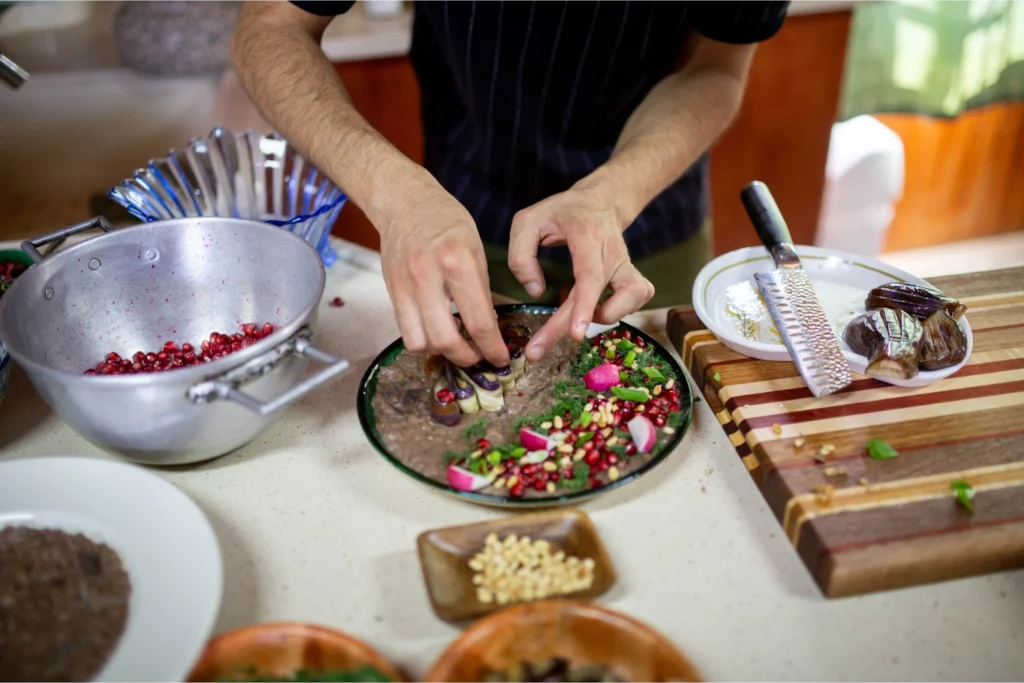
Rummaniyeh is a reflection of the Palestinian people’s resilience as well as its rich culinary traditions. It carries with it stories of survival, of displacement, and of an unbroken connection to the land and its produce. The name “Rummaniyeh” comes from the Arabic word “rumman,” meaning pomegranate. While the dish uses only a modest amount of the fruit, the tangy, bold flavor comes through, despite the earthy base of eggplant and lentils.
Originally from Jaffa, Ramla, and Lydd, Rummaniyeh was a staple dish in these cities before 1948, when the Palestinian people were uprooted. My mother’s family, like many others, fled from Ramla during the Nakba and sought refuge in Gaza City. It was there, in the Rimal area, that my grandmother continued to cook the dishes she had grown up with. These recipes became the culinary heritage passed down through generations, and in Gaza, Rummaniyeh became a soulfood-style dish now closely associated with the region.
As a child, I would sit at my grandmother’s table in Gaza City eating her Rummaniyeh. She liked to cut the eggplant into large chunks, and I was so deceived by the vegetable’s rich flavor that I thought I was eating meat! Today, when I prepare vegetarian or vegan dishes, I always reach for eggplants, knowing how their texture and flavor can recreate that comforting, satisfying experience for others.
Our visits to Gaza were an annual tradition, a time when we reconnected with my mother’s side of the family. Every summer, from 1985 until 2000, we would spend two months in Gaza. A taxi would come to our home in the Old City of Jerusalem and drive us straight to my grandmother’s house in Gaza City. Over the years, however, I witnessed the slow tightening of restrictions. Each summer, the checkpoint at Erez became more heavily fortified, with more searches and regulations. By 2000, Gaza was completely sealed off, and we could no longer make our regular visits.
I feel incredibly lucky to have returned to Gaza twice in recent years. The first was for my sister Amina’s wedding in 2008, after she had moved to Gaza City. The second, in May 2023, was for a project with the United Nations, which secured our travel permits. Being able to visit Gaza before it was reduced to rubble, to see my family’s home and walk the streets of my childhood memories one last time, was truly a blessing. And now, its bittersweet memories are what will carry on.
Rummaniyeh is not just one of my favorite dishes because of its simplicity. In fact, despite that simplicity, those earthy lentils and eggplant and the tangy kick from the pomegranate make for a balance of textures and tastes unlike any other. It’s also one of the few dishes I know where eggplant is boiled. Finally, while it’s naturally vegan, it is also packed with protein and heartiness, making it a fulfilling meal.
In every bite of Rummaniyeh, I taste my history, my heritage, and the memories of summers spent with family in Gaza. It’s a dish that reminds me of the strength of our cultural traditions, even in the face of displacement and hardship.
As with most every dish of Palestinian cuisine, there is a story – of a land, a people, and a history that refuses to be forgotten. It is the dishes that remind us of where we come from, and the enduring strength of cultural traditions that can survive even the most challenging of circumstances.
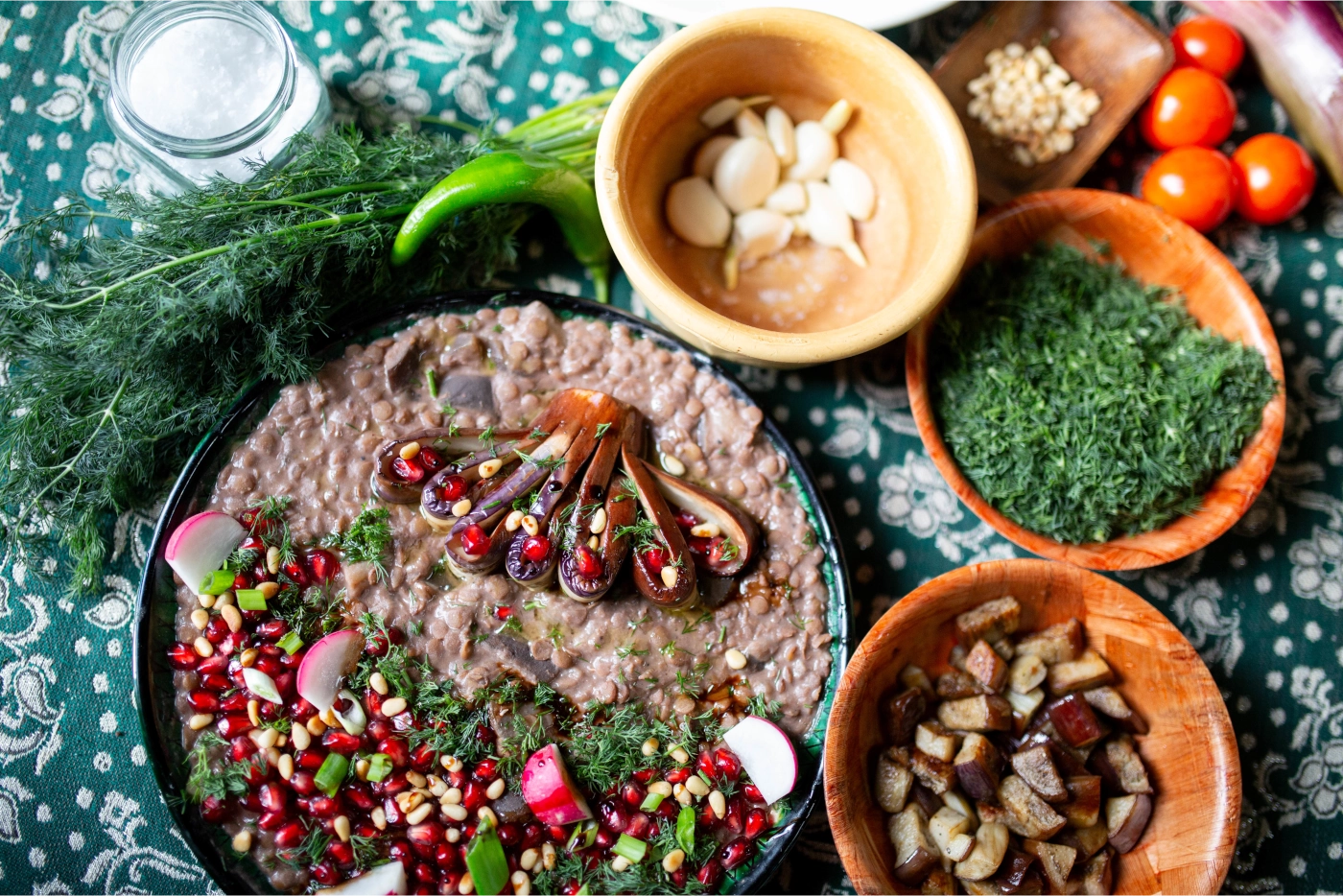
Sacred Cuisine’s Rummaniyeh Recipe
- 1.5 cups brown lentils (350g)
- 3 small eggplants (about 650g)
- 1 head of garlic (25g)
- 2 medium red chilies (25g)
- ⅓ cup tahini (75g)
- 1 cup fresh pomegranate juice or ½ cup pomegranate molasses (120g)
- 2 tablespoons ground dill seeds
- 1 cup fresh dill (15g)
- 1 teaspoon ground cumin (4g)
- 2 teaspoons ground coriander (7g)
- 2 teaspoons salt (10g)
- Pomegranate seeds
- Radish slices
- Green onions, chopped
- Fresh dill, chopped
- Pine nuts
- Additional tahini
Instructions:
- Prepare the Lentils
Rinse the brown lentils thoroughly under cold water. Place them in a pot, cover with
water, and bring to a boil. - Prepare the Eggplant
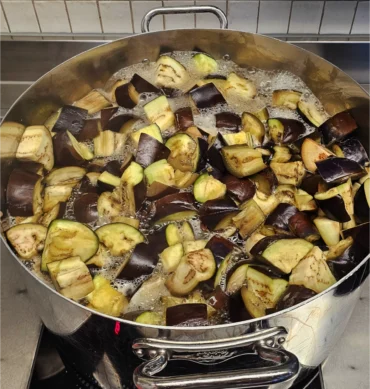
While the lentils are cooking, peel the eggplant lengthwise in strips, leaving some sections unpeeled. Then cut the eggplants into large-sized cubes. - Cook the Eggplant
Once the lentils have boiled and are nearly tender, add the cubed eggplant to the pot with the lentils. Ensure there is enough water to cover the eggplants, then continue cooking until the eggplants are soft and have sunk to the bottom. - Reduce the Liquid
Drain the excess water from the pot, leaving about 1/2 cup of liquid with the lentils and eggplants. - Add Tahini and Pomegranate
Stir in the tahini and pomegranate juice or molasses. Mix well until fully combined. - Prepare the Aromatics
Finely chop the garlic and red chilies. In a separate pan, heat some olive oil over medium heat. Add the chopped garlic, dill seeds, a pinch of salt, ground cumin, and ground coriander. Sauté until the garlic becomes golden and fragrant. - Combine Flavors
Pour the aromatic mixture into the pot with the lentils and eggplants. Stir thoroughly to combine all ingredients. - Adjust to Taste and Let Cook
Taste the mixture and adjust the seasoning with additional salt or spices if you so please. Allow everything to cook together for about 5 minutes, letting the flavors meld. - Plate, Serve & Enjoy
Pour into a shallow serving dish and let it sit for at least 30 minutes. This dish is eaten at room temperature. Garnish with pomegranate seeds, radish slices, chopped green onions, and a drizzle of tahini and olive oil, if desired.